of the positions considered entry-level in the cited analysis required prior relevant work experience.
CASE STUDY · PRODUCT DESIGN
Making the path to a first job easier to navigate
The world’s first personalized university career center.
A platform designed to help students take greater control of their career journey, organize applications and move toward the right opportunities with more clarity.
01Understand
CONTEXT
Getting a first opportunity doesn’t always mean finding a role that was actually designed for someone just starting out.
Entering the job market can be especially difficult for students and recent graduates because many positions labeled as entry-level still expect previous experience.
The project started from that contradiction: to gain experience, you first need an opportunity — but many entry-level opportunities already expect candidates to come in with experience.
of entry-level roles in software and IT services required three or more years of experience.
The original exercise referenced an analysis of nearly 4 million LinkedIn job postings published since late 2017.
Talent can be everywhere, but many entry-level opportunities still aren’t designed for people who are just starting their careers.
THE STUDENT CHALLENGE
Finding job openings wasn’t enough. The experience also needed to support everything that came after.
For students, the search doesn’t end when they find an interesting opportunity. They also need to understand whether it fits their profile, remember where they applied, keep track of multiple processes and know what is happening with each one.
When all that information lives in different places, it’s easy to lose context and feel like every application disappears the moment you hit “Submit”.
The product idea was broader: a personalized university career center that could bring opportunities, tracking and communication together in one experience.
Goal
Design an experience that helped students discover opportunities, organize their applications and keep enough context to move toward their first professional experience with more clarity.
02Prioritize
BRINGING ORDER TO A SCATTERED PROCESS
Not everything needed to be solved at once.
The concept had room to grow into many areas of career development, but for this proposal it was important to focus first on the moments that could bring the most clarity to students.
The experience needed to support four key actions: discover opportunities, organize active applications, understand the status of each process and keep the information needed to decide what comes next close at hand.
Discover
Find relevant opportunities without separating the search from the rest of the journey.
Apply
Take the next step while keeping the resume and opportunity details in the same context.
Track progress
Know where each application stands and what needs to happen next.
Stay connected
Keep communication and context available while the student and the company move through the process.
Finding an opportunity was only the beginning. The important part was staying oriented across applications, statuses and next steps.
03Explore & decide
AN EXPERIENCE THAT SUPPORTS THE FULL PROCESS
Finding an opportunity was only one part of the journey.
The concept connected different moments of the job search within the same experience: discovering opportunities, applying, keeping track of each process and following up without relying on external tools.
From the student profile, users could review application details, submit their resume, create follow-up tasks and stay in touch with the company throughout the process. At the same time, companies could publish openings and connect with candidates from the same platform.
Discover opportunities→Apply→Track progress→Stay connected
MAKING PROGRESS VISIBLE
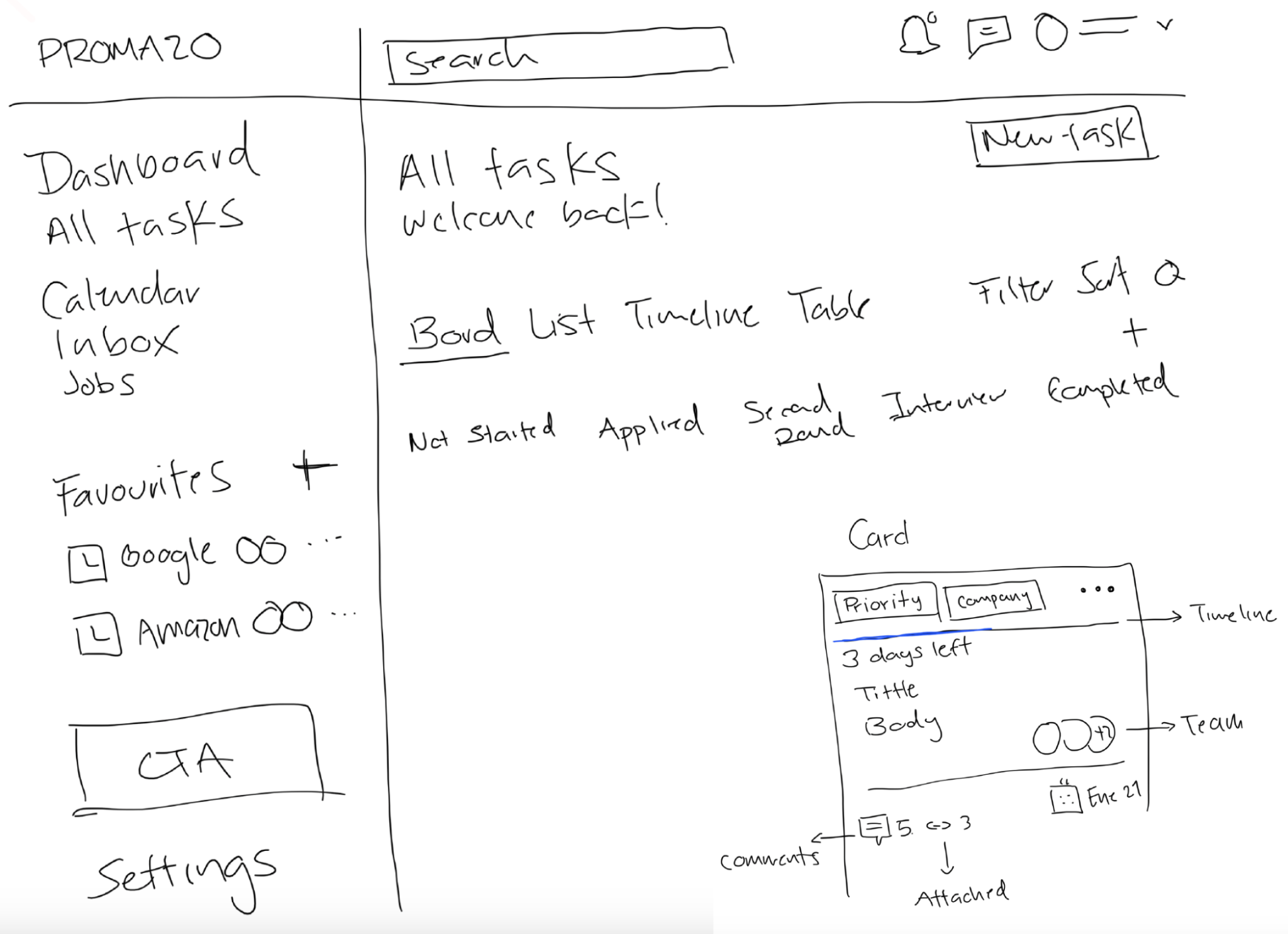
The Kanban board was a product decision
The board turned a process that often feels abstract into something tangible. Each application had a place in the flow and could move between stages as the process evolved.
That made it easier to quickly understand which applications were still active, which had progressed and which needed attention — without losing sight of the rest of the search.
04Build & adapt
FROM THE BIG PICTURE TO THE DETAILS
Every application needed to keep its own context.
The solution eventually took shape around two complementary levels: an overview of all applications and a dedicated space to go deeper into each opportunity.
The goal was to move from “Where are all my applications?” to “What’s happening with this opportunity?” without losing orientation along the way.
Opportunity details
Description, tags, priority and status stay together so students don’t have to rebuild context every time they return.
Tasks & next steps
Students can create follow-up actions and keep important dates visible throughout the process.
Resume & documents
Files related to the application stay available within the same space.
Feedback & reflection
A journal provides room to save notes, learnings and feedback beyond the current status of the opportunity.
OUTCOME
Making the path to a first job more visible.
The concept brings opportunities, tracking and context into the same space so students can better understand where they are and what comes next.
Rather than treating each application as an isolated action, the experience keeps a broader view of the journey — from discovering an opportunity to following an active process.
01
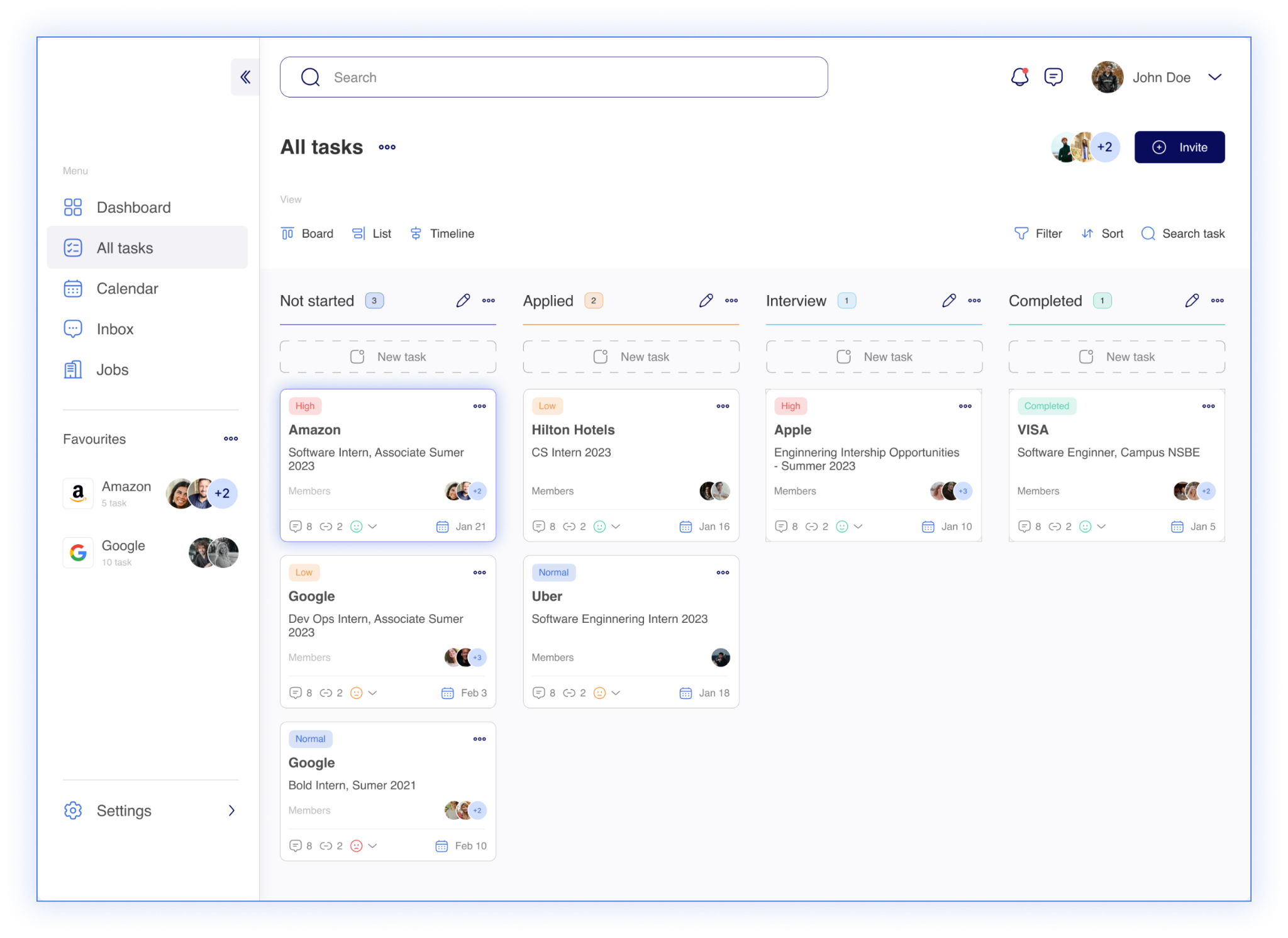
A clear overview of the process
The board brings multiple opportunities together without forcing students to reconstruct what was happening in each one.
- Visible stages. Each application clearly shows where it stands in the process.
- Priorities & dates. The information needed to decide what to focus on next remains visible.
- Follow-up in context. Actions related to each opportunity stay connected to the same journey.
02
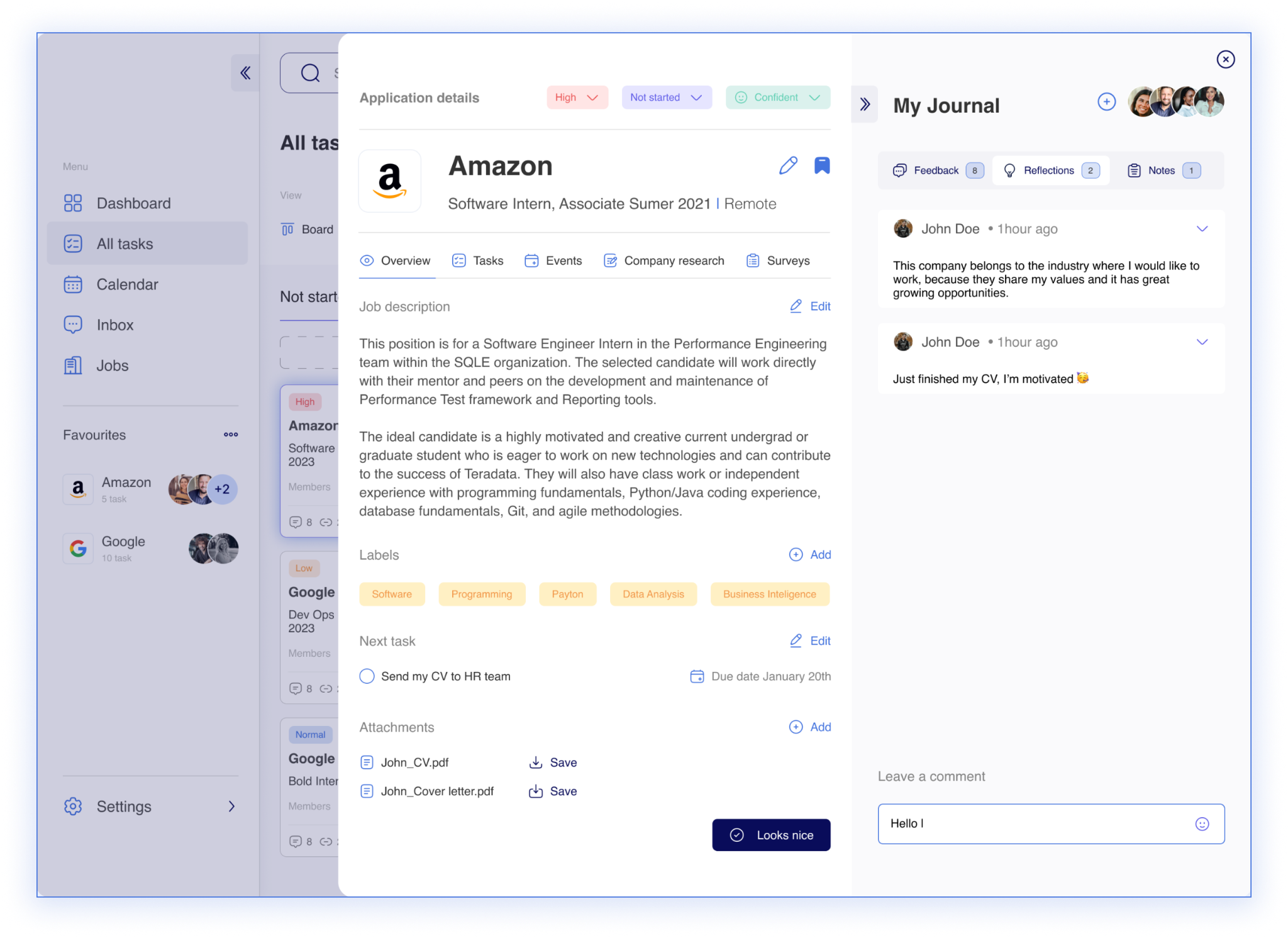
Every opportunity keeps its context
The detail view lets students go deeper into an application without separating the information, actions and learning generated throughout the process.
- Opportunity details. Description, status, priority and tags remain together.
- Tasks & documents. Resume, files and next steps stay within the same space.
- Feedback & reflection. Notes and learnings remain part of the application beyond its current status.
CLOSING
Conclusions & next steps
Designing for a first job opportunity also meant designing for uncertainty, follow-up and the need to preserve context while the process keeps moving.
Look beyond the job posting
Finding an opportunity is only one part of the journey. The experience becomes more useful when it also helps students move forward after they apply.
Make progress visible
Stages, tasks and next steps reduce the feeling that an application simply disappears after it has been submitted.
Keep context together
Each application needs a place where information, documents, notes and follow-up can live without forcing students to reconstruct the process every time.
Taking the first professional step already comes with enough uncertainty. Organizing the journey shouldn’t add more.
← Back to case studies